Home page for the electron
microprobe (EPMA)
We wish to first acknowledge the funding provided most recently from ONAMI (Oregon Nanoscience and Microtechnologies Institute), the National Science Foundation, the Murdock Foundation, and the W.M. Keck Foundation, and as well for funding early in this facility's history from the National Aeronautic and Space Administration. Because of this generous grant support we can provide students and researchers at the University of Oregon an CAMECA SX100 electron microprobe.
The Cameca SX100 electron microprobe is used for high accuracy elemental characterization on the micro (bulk samples) and nano scales (thin films) for major, minor and trace element concentrations. It can provide qualitative (identification) and quantitative (composition) for Be to U and also x-ray, secondary, backscatter and cathodo-luminescence imaging. They typically produce results with better than a few percent accuracy for compositions over the entire periodic table and even better accuracy for silicates, ceramics and glasses. The SX100 is equipped with 5 WDS, SE, BSE and cathodo-luminescence detection, also a Thermo Pathfinder SDD EDS spectrometer (10 sq. mm) for spectrum imaging and phase mapping.
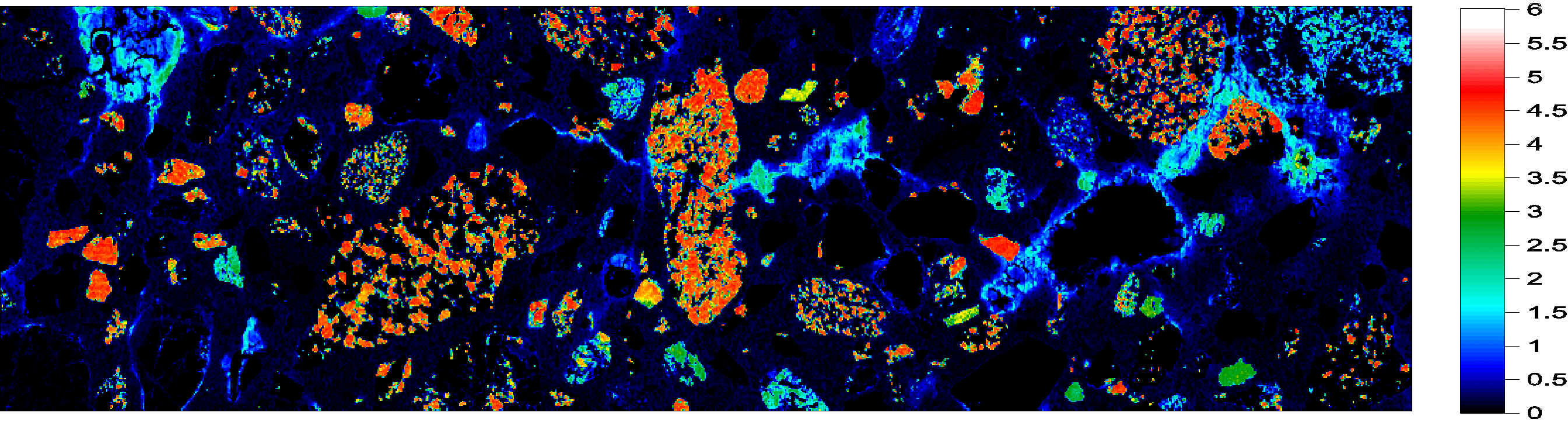
Our masthead image is an example of what capabilities we have available. This image demonstrates wide area quantitative imaging by mapping the spatial distribution of elements, in this case Na in a cement mortar. The field of view here is approximately 10 mm wide and was mapped using a wavelength dispersive spectrometer. Although the field of view is large, the spatial resolution is quite high, in this case 2048 pixels wide. Here, the color is correlated to Na concentration in weight percent and is quantitatively indicated by the color scale bar to the right of the image. The software was MicroImage and Probe for EPMA by Probe Software (www.probesoftware.com) and Surfer by Golden Software (www.goldensoftware.com). Look for more specific information on our instrument's capabilities via their hyperlinks.
Introduction to Electron Probe MicroAnalysis
GEOL 619 Course in Electron Microprobe Analysis
Laboratory Location and Shipping Addresses
Standard "Fee for Service Agreement" for CAMCOR Analytical Services (short form)
Standard "Fee for Service Agreement" for CAMCOR Analytical Services (long form)
Standard and Custom Sample Size Specifications
Instrument User Schedules:
Facility Description Brochures:
Operation of the Instruments:
Principal UofO researchers
Image Galleries
Technical Information on the Techniques
Resources
Workshops
Papers, Talks and Posters Presented
Obsolete Web Pages
Software Downloads and Updates
Electron Beam Micro Analysis Course (CH 610, PHY 610 and GEOL 619)
Weird Science Seminar
I teach a Freshman seminar each Fall on the differences between science and pseudo-science. Not always an easy division to make for many scientists, much less the general public. Here is a link to my Weird Science page:
Personal
Donovan's personal opinions, debates, rants, favorite pictures, original music, and other colorful items can be found here:
Historical Stuff
New Physical Location Starting 2008!
Have a question for the laboratory manager? My name is Julie Chouinard. Please feel free to make suggestions to epmalab@uoregon.edu. Call me at 541 346-4580. Or try the lab phone at (541) 346-4655.